Why You Never Get to the Important Work (and the 70-Year-Old Fix)
Jul 17, 2026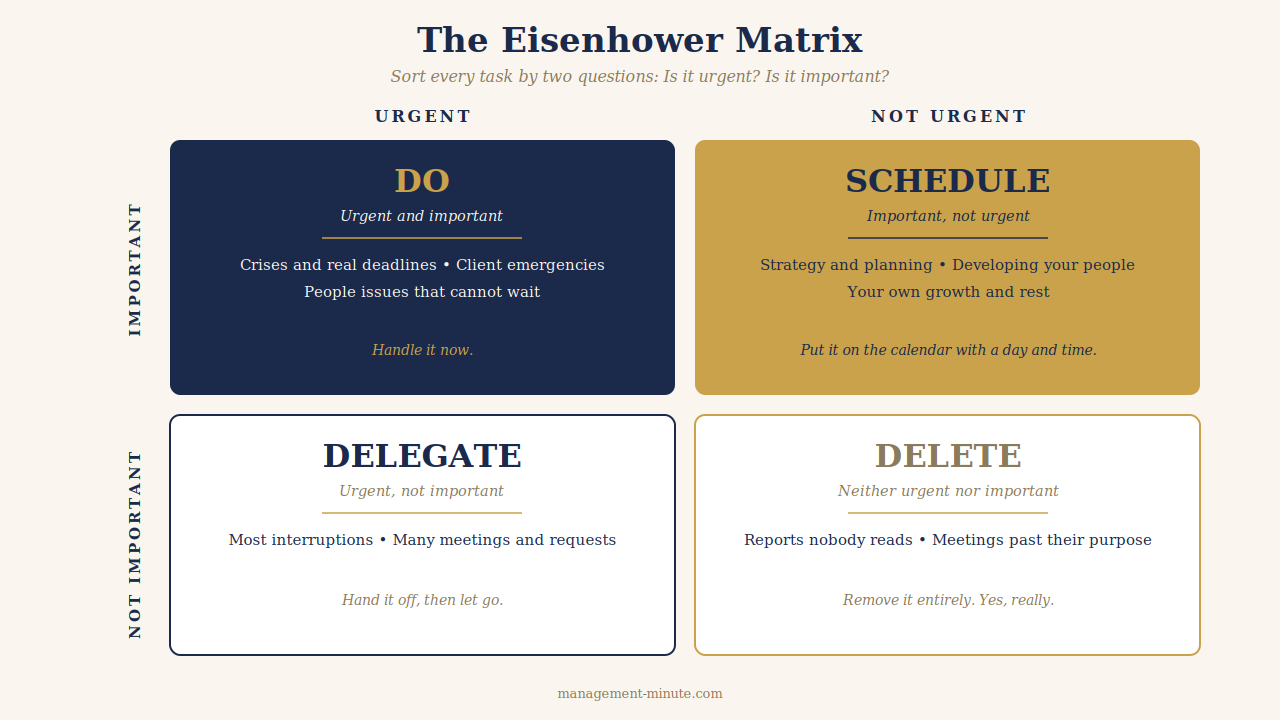
Your to-do list is lying to you.
Not about what's on it. About what matters on it. If you're like most managers I coach, your list is a mix of real priorities, other people's emergencies, and things that landed there simply because someone put a deadline on them. And here's the uncomfortable part: research says your brain will pick the deadline over the priority almost every time.
I want to walk you through a tool that has helped me and my clients cut through that noise for decades. It's called the Eisenhower Matrix, and it takes about ten minutes to learn and a career to master. This post covers where it came from, why the research behind it is more relevant now than ever, and exactly how to use it this week.
Why Your Brain Chooses Urgent Over Important
In 2018, researchers Meng Zhu, Yang Yang, and Christopher Hsee published a study in the Journal of Consumer Research that put a name to something every manager feels. Across five experiments, they found that people consistently chose to work on tasks with objectively lower payoffs when those tasks felt urgent, even when the researchers controlled for all the sensible reasons someone might do that. A ticking clock, all by itself, was enough to pull people away from higher-value work.
They called it the mere urgency effect.
Sit with that for a second. The tasks didn't matter more. They weren't easier. They didn't unlock anything. They just had a deadline attached, and that was enough.
If you've ever ended a packed week wondering why the strategic plan, the development conversation with your rising star, or the process fix you've been meaning to tackle still hasn't moved, this is why. It's not a discipline problem. It's a wiring problem. And wiring problems need systems, not more willpower.
Where the Eisenhower Matrix Came From
President Dwight Eisenhower saw this pattern long before behavioral researchers measured it. In a 1954 speech, he shared a line he attributed to a former college president: "I have two kinds of problems: the urgent and the important. The urgent are not important, and the important are never urgent."
Eisenhower knew something about competing demands. He commanded the Allied forces in Europe, served two terms as president, and along the way built a reputation for calm, deliberate decision making under enormous pressure. The framework that grew out of his observation is disarmingly simple. Stephen Covey later popularized it in The 7 Habits of Highly Effective People, where it appears as the time management matrix, and it has been a staple of leadership development ever since.
The idea is this: every task in front of you can be sorted along two dimensions. Is it urgent? Is it important? Those two questions create four quadrants, and each quadrant gets its own verb.
The Four Quadrants Explained
Quadrant 1: Urgent and Important. Do it now.
This is the fire that's actually burning. A client crisis, a real deadline, an employee situation that can't wait until Monday. Quadrant 1 work is legitimate and unavoidable. The goal isn't to eliminate it. The goal is to keep it from becoming your whole job. If everything in your week lives here, that's a signal worth paying attention to, and we'll come back to it.
Quadrant 2: Important but Not Urgent. Schedule it.
This is the quadrant that builds careers and teams. Strategy. Developing your people. Building relationships before you need them. Fixing the broken process instead of working around it again. Your own learning and rest.
Nothing in Quadrant 2 will demand your attention today. That's exactly the problem. This is the quadrant the mere urgency effect steals from, one reasonable-sounding day at a time. The managers I coach who feel stuck almost always have a graveyard of Quadrant 2 intentions, and the managers who grow are the ones who defend this quadrant on their calendar like it's a client meeting.
Quadrant 3: Urgent but Not Important. Delegate it.
Most interruptions live here. Many meetings live here. Requests that are urgent to someone else but don't require your specific judgment live here.
Delegation gets a bad reputation as offloading, but done well it's development. The task that's routine to you may be a stretch assignment for someone on your team. When you hold onto Quadrant 3 work, you're not just crowding your own calendar. You may be blocking someone else's growth.
One honest caution: delegating requires that you actually let go. Handing someone a task and then hovering over every step isn't delegation. It's supervision with extra steps.
Quadrant 4: Neither Urgent nor Important. Delete it.
The report nobody reads. The recurring meeting that outlived its purpose. The scroll that started as a two-minute break. This quadrant is where time goes to disappear, and the kindest thing you can do for your future self is remove these items entirely rather than reschedule them into next week.
How to Use the Matrix This Week
Frameworks are only useful if they survive contact with a real Tuesday. Here's the version I give clients.
Step one: dump the list. Take fifteen minutes and write down everything currently competing for your attention. Everything. The strategic project and the expense report. Don't sort yet. Just get it out of your head and onto paper.
Step two: ask the two questions. For each item, ask: Does this have a real deadline or consequence in the next few days? That's urgency. Then ask: Does this move my team, my mission, or my growth forward in a meaningful way? That's importance. Be honest. The mere urgency effect works by disguising urgent tasks as important ones, so if you catch yourself justifying an item with "but someone is waiting on it," pause and check whether the waiting actually matters.
Step three: sort into the four boxes. Most people are surprised by two things when they do this. First, how little truly lives in Quadrant 1. Second, how much has quietly piled up in Quadrant 3, wearing an importance costume.
Step four: schedule Quadrant 2 with a day and a time. This is the step that changes everything, and it's the one most people skip. An unscheduled important task loses to an urgent task every single time. A scheduled one has a fighting chance. Don't write "work on succession plan this week." Write "succession plan, Thursday, 9:00 to 10:30." Then protect that block the way you'd protect a meeting with your boss.
Step five: have the delegation conversations. For each Quadrant 3 item, identify who could own it and what they'd need from you to succeed. Then hand it off with clear expectations and a check-in point, not a leash.
What Your Quadrants Are Telling You
After you've used the matrix for a few weeks, it stops being just a sorting tool and starts being a diagnostic.
If Quadrant 1 dominates every week, you're not managing. You're firefighting. Chronic Quadrant 1 overload usually points to something upstream: understaffing, unclear priorities from above, or Quadrant 2 work that got deferred so long it caught fire. The fix isn't working faster. It's tracing the fires back to their source.
If Quadrant 3 dominates, you have a boundary problem or a delegation problem, and sometimes both. Other people's urgency has colonized your calendar. The question worth asking is why their emergencies keep becoming yours.
If Quadrant 2 is consistently empty, your future is being spent on your present. That's sustainable for a sprint and corrosive over a career.
And if you can't bring yourself to delete anything from Quadrant 4, ask what those tasks are giving you. Sometimes busy work is a hiding place, and low-stakes tasks feel productive precisely because they can't fail in any way that matters.
A Note for Managers Who Lead Teams
Everything above works for your own list. But if you lead people, you also shape the urgency culture your team lives in.
Every "quick question" you send at 6 p.m., every same-day request that could have waited, every meeting called without a clear purpose teaches your team what urgent means in your world. If your team seems permanently stuck in Quadrants 1 and 3, look first at the signals coming from you.
Try this: in your next one-on-ones, ask each person to sort their current work into the four quadrants and walk you through it. You'll learn more about their workload in twenty minutes than a month of status updates would tell you, and you'll almost certainly find Quadrant 3 work you can pull off their plate or officially deprioritize. Clear expectations about what actually matters are a gift. As Brené Brown puts it, clear is kind.
The Matrix Won't Do the Hard Part
I'll be honest with you about the limits of this tool, because a framework oversold is a framework abandoned.
The matrix will not make hard tradeoffs for you. It will show you that the grant application and the team retreat planning are both important and both unscheduled, but it won't tell you which one gets Thursday morning. That's judgment, and judgment is your job.
It also won't hold the line for you. The mere urgency effect doesn't disappear because you drew four boxes. Wednesday afternoon will still arrive with something that feels pressing, and the scheduled Quadrant 2 block will still be the easiest thing on your calendar to sacrifice. The discipline isn't in the sorting. It's in what you do when urgency comes knocking on time you already promised to importance.
But here's what the matrix does do, reliably: it makes the choice visible. Before, you drifted toward urgent work without noticing. Now, when you bump the succession plan for the third week in a row, you'll know you're doing it. And a visible choice is one you can change.
Start With One List
You don't need a new app, a new planner, or a Monday to start. You need your current to-do list, two questions, and fifteen minutes.
Sort the list. Schedule what's important. Hand off what isn't yours to carry. Delete what never mattered. Then watch what happens to the work that actually builds something.
What is one important, non-urgent task that has been on your list for more than a month? That's your Thursday morning.
Sources:
Zhu, M., Yang, Y., & Hsee, C. K. (2018). The Mere Urgency Effect. Journal of Consumer Research, 45(3), 673–690.
Eisenhower, D. D. (1954). Address at the Second Assembly of the World Council of Churches, Evanston, Illinois.
Covey, S. R. (1989). The 7 Habits of Highly Effective People. Free Press.
Ready to put this to work with your whole team? My Revitalize Your Routine workshop helps teams rebuild how they spend their time, delivered in person or virtually. Schedule a 30-minute conversation.
And if you'd like one practical management idea in your inbox each week, join The Management Minute. Two short emails a week: Thursdays bring a tip and a topic, and Sundays are a little more personal. Both are quick reads. Subscribe here.